
If you’ve ever tried to explain what you do for work and watched someone’s eyes glaze over the moment you said “PLC,” you already know the problem. The title “controls engineer” tells people almost nothing about what your actual day looks like, and honestly, most job postings don’t do much better.
Here’s the thing: the day-to-day reality of a controls engineer shifts dramatically depending on where you work. Writing ladder logic for an automotive stamping line feels nothing like commissioning a SCADA system for a municipal water treatment plant. Same core skills, completely different world.
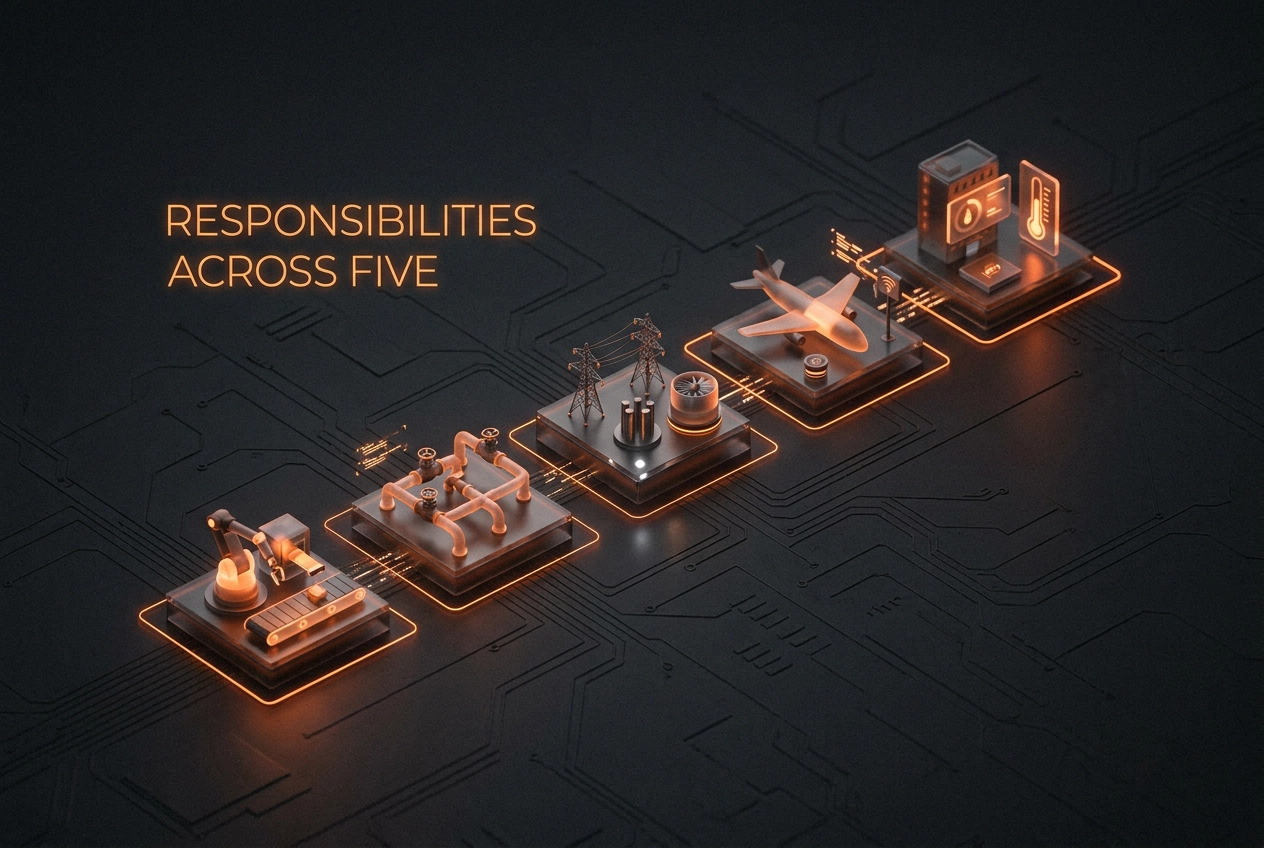
This post cuts through the abstract job descriptions and gets specific. We’ll walk through what a realistic working week looks like across five major industry verticals: oil and gas, automotive, food and beverage, water treatment, and building automation. Along the way, we’ll cover how skills transfer between those verticals, which emerging trends are already changing the role, and how to figure out which environment actually suits the way you like to work. Whether you’re eyeing a career pivot or just trying to understand your options, this one’s for you.
The Core Loop Every Controls Engineer Lives In
No matter which industry you work in, the controls engineer job description traces the same path every single time: design, program, test, troubleshoot. Repeat. The industry vertical changes what each phase looks like in practice. The loop itself never does.
A realistic week looks something like this:
- Monday morning: reviewing updated electrical schematics for a new conveyor section
- Tuesday: three hours in Studio 5000 editing ladder logic, interrupted by a fault call from the floor
- Wednesday: coordinating with maintenance on a scheduled PM window
- Thursday: back to the fault from Tuesday, which turned out to be a wiring issue that required a deeper look at the I/O module
Sometimes all four of those things happen on the same day. That’s not unusual; that’s the job.
What makes the role genuinely demanding is that it sits at the intersection of production targets, capital asset protection, and safety compliance. Downtime is never just a technical inconvenience. A stopped line, a tripped SIS, a runaway process: each one has a dollar value and sometimes a safety consequence. Controls engineers work inside frameworks like NFPA 70E for electrical safety and OSHA standards for process safety, not as background knowledge but as active daily constraints. Understanding the business pressure behind every fault call is part of the competency, not a bonus trait.
The credential baseline is consistent across job postings: a Bachelor’s degree in electrical engineering or a closely related field, plus 3 to 6 years of hands-on PLC programming and SCADA experience. But vertical-specific knowledge often carries equal weight in a hiring conversation. An engineer with deep food and beverage sanitation logic experience brings something a general EE degree does not.
Most controls engineers land in one vertical early in their career and build from there. The good news is that the fundamentals do transfer. The honest caveat is that the daily texture of the work, the platforms you spend most of your time in, and the regulatory pressures shaping every design decision are different enough across verticals that they deserve serious evaluation before a career move.
That’s exactly what the rest of this post unpacks. If you want a broader sense of how one engineer approaches the discipline, Atsu Bedjean’s controls engineering blog covers that same intersection of technical depth and real-world perspective. For now, let’s get into the verticals.
Oil and Gas: High-Stakes Troubleshooting in Hazardous Environments
Oil and gas is where the financial weight of a controls fault becomes very real, very fast. A sensor reading out of range on a compressor station or wellhead skid can trip a safety instrumented system (SIS), and depending on the asset, that unplanned shutdown can cost tens of thousands of dollars per hour in lost throughput, restart costs, and deferred production. That context shapes how engineers approach every task, from routine loop tuning to alarm rationalization.
Regulatory framework is the spine of the workday here. API RP 554 governs how process control systems are documented, and RP 505 addresses electrical area classifications in hazardous locations. IEC 61511 sits on top of all of it, defining how safety instrumented functions are designed, verified, and maintained. In practice, this means controls engineers spend real time documenting safety integrity levels (SIL), maintaining cause-and-effect matrices, and participating in HAZOP reviews alongside process engineers and operations teams. If you have never written a SIL verification report or sat through a structured HAZOP session, expect a steep learning curve in your first few months.
Platform familiarity is not portable by default. The dominant DCS and PLC environments in this vertical include Emerson DeltaV, Honeywell Experion, and Allen-Bradley ControlLogix. Each has its own logic editor, alarm management architecture, and historian integration approach. An engineer comfortable in ControlLogix will not step into a DeltaV environment and immediately be productive; the mental model transfers but the toolchain does not. Budget time for that cross-training, and do not undersell it in interviews.
Remote and offshore operations change the daily rhythm fundamentally. A plant-floor controls engineer walks to the panel. An offshore or pipeline engineer opens a SCADA session first, diagnoses remotely, and then decides whether a site visit is warranted given travel logistics. That shift from reactive to deliberate troubleshooting requires a different kind of documentation discipline and sharper remote diagnostic skills, including comfort with historian trends, network diagnostics, and virtual HMI navigation under pressure.
Skill transfer note: The P&ID literacy and SIS documentation habits built in oil and gas carry strong value into water treatment and chemical processing, where IEC 61511 and HAZOP methods are similarly relevant. Moving into food and beverage or building automation is a different story; the regulatory language, sanitation logic, and DDC controller environments feel like a separate professional dialect rather than a variation on the same theme.
Automotive: High-Volume Production Lines and Relentless Cycle Times
If oil and gas is about surviving a high-stakes, slow-burn process environment, automotive is the opposite: everything is fast, the line never wants to stop, and everyone knows exactly how much a minute of downtime costs.
Cycle time is the metric that runs your day. A body weld line running 60 units per hour has roughly 60 seconds per station. When a fault trips a robot or a safety gate, the clock starts immediately and production supervision is already watching. There is no leisurely root-cause analysis session on a live line. You diagnose, you fix, you document, and you do it fast enough that the shift manager doesn’t escalate.
Robot integration is a core daily skill here, not a specialty. Most automotive facilities run FANUC, KUKA, or ABB robots alongside conventional PLC hardware, and the programs don’t speak the same language. Your ladder logic and structured text live in the PLC; the robot runs Karel (FANUC) or RAPID (ABB) on its own controller. Knowing where PLC I/O handshaking ends and robot program logic begins is something you’ll navigate multiple times a week. Controls engineers who only know one side of that boundary spend a lot of time hunting faults in the wrong place.
Shift culture is a real operational layer. Automotive controls engineers routinely support two or three shifts, attend pre-shift meetings to review overnight fault logs, and carry on-call responsibility for critical lines. This is not incidental to the job; it shapes your schedule, your communication style, and frankly your personal life. If you’re coming from a Monday-to-Friday project environment, the cultural adjustment is genuine.
Standards and change control are heavier here than almost anywhere else. Network architecture follows OEM-specific requirements, typically built on EtherNet/IP or PROFINET, with legacy DeviceNet still present in older tooling. More importantly, engineering changes to live tooling programs often require formal PPAP (Production Part Approval Process) documentation before deployment. You don’t just push an edit and move on.
Skill transfer note: The fast-fault-response instincts and network diagnostics depth you build in automotive carry over well to food and beverage packaging lines. The difference engineers usually notice when they leave the vertical is that the pace of formal change approval is slower almost everywhere else, and they find that disorienting at first.
Food and Beverage: Sanitation Cycles, Recipe Management, and FDA Compliance
Food and beverage feels familiar coming out of automotive, but the pace shift is real, and the regulatory layer is something else entirely.
The biggest time split here is between production support and sanitation sequences. CIP (clean-in-place) and COP (clean-out-of-place) cycles run between every product changeover, and the controls engineer owns that logic. This is not a maintenance concern in the traditional sense. A misconfigured rinse temperature, a skipped valve step, a timer set two minutes short: these are food safety events. They can trigger a recall. Understanding that distinction changes how you write and validate the code.
The documentation burden compounds the sanitation work. FDA 21 CFR Part 11 sets the rules for electronic records and electronic signatures in regulated food environments, which means your HMI audit trails, electronic batch records, and recipe management systems must meet specific validation and data integrity standards. If you have never worked in a regulated food plant, this layer will feel genuinely foreign. Immutable audit trails, user-level electronic signatures, validated recipe version control: these are not optional configurations on your FactoryTalk project, they are compliance requirements.
PMMI recognizes controls engineering as a core career path in packaging and processing, and the day-to-day backs that up. Engineers here spend meaningful time working directly with OEM packaging machine vendors, pulling third-party equipment into the plant SCADA architecture. That integration work demands strong communication skills alongside the technical ones; you are often debugging someone else’s proprietary code with limited documentation.
On the platform side, Allen-Bradley dominates most North American food plants, particularly FactoryTalk View and Studio 5000. Facilities running European OEM equipment frequently bring in Siemens TIA Portal alongside it. Knowing both is a real differentiator on the job market, not just resume padding.
Skill transfer note: Recipe management and batch process logic built in food and beverage carry well into pharmaceutical and specialty chemical manufacturing. The sanitation competency, though, does not have a clean parallel in most other verticals. It is increasingly showing up as a screening criterion in food and bev job postings, not a bonus.

Water Treatment: SCADA-Heavy Operations With Long Maintenance Windows
If food and beverage is defined by sanitation logic and recipe management, water treatment is defined by geography and telemetry scale.
A single operator console at a municipal utility might supervise 30 or 40 remote lift stations, chlorination dosing points, and pump banks scattered across an entire county. The controls engineer owns the SCADA architecture that ties all of it together: the polling logic, the remote I/O configuration, the alarm thresholds, and the historian data feeding compliance reports. There is no equivalent in most manufacturing environments.
The regulatory layer is non-negotiable. The Safe Drinking Water Act and the Clean Water Act both impose compliance monitoring obligations that run directly through the control system. AWWA standards add design and documentation requirements on top of that. Controls engineers here need to understand where their telemetry data goes after it leaves the SCADA screen, because that data often feeds state-level regulatory reporting. If you treat compliance documentation as someone else’s problem, you will not last long in this vertical.
The pace is genuinely different. An unplanned fault at a lift station is serious, but it rarely triggers a cost-per-minute clock the way a stopped automotive line does. That means you typically have a structured investigation window rather than a 10-minute fix-it-or-else scenario. The tradeoff is that project work runs alongside operations support in a more disciplined way; you might be commissioning a new aeration control upgrade while still handling day-to-day alarm management.
Cybersecurity is no longer a background concern here. Water infrastructure is designated critical infrastructure, and the EPA has formally flagged increasing cyberattacks on public water systems as a compliance-level issue. NIST 800-82 is increasingly showing up in procurement specs and system design reviews, not as a best-practice suggestion but as a contractual requirement. If your SCADA experience predates serious OT security awareness, expect a real learning curve when you enter this vertical.
Skill transfer note: The SCADA depth and remote I/O troubleshooting experience you build in water treatment maps well to oil and gas pipeline operations and building automation, where geographically distributed architectures are similarly common. Engineers moving in from high-speed manufacturing usually need to recalibrate expectations; the work is technically demanding, just measured in weeks and months rather than seconds and shift reports.
Building Automation: HVAC Logic, Energy Management, and BAS Integration
Building automation sits at a different point on the controls spectrum than anything covered so far. The PLC-centric mindset that dominates manufacturing and water treatment gives way here to DDC (direct digital control) controllers communicating over open protocols: BACnet, LonWorks, and Modbus. A BAS engineer’s daily toolkit is built around these protocols and the sequence-of-operations logic that ties HVAC, lighting, access control, and energy systems together across commercial buildings, hospitals, universities, and industrial campuses.
The regulatory backbone is ASHRAE. Standards 62.1 (ventilation) and 90.1 (energy efficiency) are not background reading; they are the specification that controls logic has to satisfy. When you write economizer logic or demand-controlled ventilation sequences, you are translating code compliance directly into DDC programming. ASHRAE 62.1 is under continuous maintenance, with addenda issued regularly through 2025, so sequences you wrote two years ago may need revisiting as jurisdictions adopt updated requirements.
Energy performance is increasingly the daily scorecard. By 2026, a significant chunk of a BAS engineer’s week goes toward analyzing trend data in energy dashboards and tuning setpoints to meet energy performance contracts. Fault detection and diagnostics (FDD) software flags underperforming air handlers, stuck dampers, and sensor drift before operators notice comfort complaints. The work has shifted from “keep equipment running” to “prove the system is running efficiently,” which requires a different analytical posture than alarm-queue management.
Commissioning is a bigger part of this job than in most other verticals. New construction commissioning (Cx) and retro-commissioning (RCx) projects demand systematic point-to-point verification, functional performance testing, and owner training. All of that typically lands on the controls engineer. If you come from a manufacturing background where commissioning was a compressed startup sprint, expect a more structured and documentation-heavy process here.
Skill transfer note: BAS engineers moving into industrial roles bring genuine strengths: network protocol fluency, systems integration experience across multi-vendor environments, and comfort with building-wide data architectures. The gaps are real but specific. Ladder logic exposure is lighter than what peers from manufacturing carry, and familiarity with industrial safety standards (IEC 61511, NFPA 70E) is usually thin. Those are learnable gaps, but budget time for them before assuming a smooth lateral move.
How Skills Actually Transfer Across Verticals
The platform gap is the first thing to get honest about. PLC programming fundamentals, ladder logic, function block diagrams, structured text, these travel with you across every vertical. The underlying logic structure is the same whether you’re sequencing a bottling line or a lift station. What does not travel is platform fluency. An engineer moving from Allen-Bradley Studio 5000 to Siemens TIA Portal, or from a DCS environment to a BAS DDC controller, should expect a real ramp-up period, not a weekend of YouTube tutorials.
SCADA architecture skills are the most portable competency in this field. Historian configuration, alarm management strategy, and remote I/O integration are valued in oil and gas, water treatment, and large food and beverage plants almost interchangeably. If you have built and maintained a SCADA architecture in one of those verticals, you have a genuine head start in the others.
Regulatory literacy is a different story entirely.
- FDA 21 CFR Part 11 applies to FDA-regulated environments with predicate rule requirements. That knowledge base is largely irrelevant at a water treatment plant operating under the Safe Drinking Water Act.
- SIL certification experience from oil and gas (IEC 61511) does not satisfy building commissioning requirements under ASHRAE or local energy codes.
- Each vertical has its own standards stack, and fluency in one does not shorten the learning curve in another as much as engineers tend to assume.
Treat regulatory literacy as vertical-specific, not general.
The soft-skill dimension is equally real and less often discussed. Automotive plants reward fast fault response and tight shift-culture communication; the expectation is that you diagnose quickly, communicate clearly to operators on the floor, and move on. Water treatment and building automation reward something different: project management discipline, long-horizon documentation habits, and stakeholder communication that runs on weeks and months, not minutes.
Before committing to a vertical change, map three things specifically:
- The dominant platforms in the target industry and your current distance from them
- The safety and regulatory standards that shape daily work there
- The communication rhythm, fast-response manufacturing culture versus slower, project-driven operations
The job title will look similar on the posting. The actual day will not.
Emerging Trends Reshaping the Controls Engineer Role

Vertical fluency and platform knowledge get you in the door. What keeps you relevant over the next decade is a different conversation.
1. AI-assisted predictive maintenance is adding a new layer to daily troubleshooting. Controls engineers in 2026 aren’t just clearing traditional alarm queues; they’re reviewing AI-generated anomaly-detection alerts that flag developing faults before a trip occurs. That changes how you triage your morning. The skill shift is learning to evaluate which alerts are actionable signals versus noise, then feeding that judgment back into how PM schedules get built.
2. Industry 4.0 integration is pulling controls engineers into data architecture conversations. Connecting OT systems to plant-level analytics platforms and MES layers requires vocabulary and design thinking that doesn’t come from ladder logic alone. If you’ve only ever worked inside the PLC cabinet, expect a learning curve around data contextualization, network segmentation between OT and IT, and communicating system constraints to people who have never seen a P&ID.
3. Cybersecurity is now a genuine hiring filter, not a nice-to-have. Water treatment, oil and gas, and any facility with internet-facing SCADA are screening for it explicitly. The two frameworks worth knowing are NIST SP 800-82 (updated to Rev. 3 in 2023, now framed around OT security broadly rather than just ICS) and IEC 62443. Neither is typically covered in a standard electrical engineering curriculum, which means self-directed learning is the only realistic path for most working engineers.
4. Remote monitoring and logic pushes are now baseline expectations. Post-2020 remote access capabilities expanded fast across every vertical, and they didn’t recede. Being able to diagnose a fault through a SCADA connection and push a tested logic revision without being on-site isn’t a specialty skill anymore; it’s assumed. If your experience is primarily bench troubleshooting and physical commissioning, that gap is worth closing deliberately.
5. Cross-vertical fluency combined with these technical competencies is what senior and principal roles increasingly require. Deep system knowledge still matters, but the higher you go, the more you’re expected to translate technical trade-offs for operations and management stakeholders who don’t share your context. Engineers who pair broad vertical experience with current competencies in OT security, data integration, and remote operations are genuinely differentiated in a market that’s still short on that combination.
Finding the Vertical That Fits Your Career
All five verticals covered in this post run on the same underlying engine: design, program, test, troubleshoot, repeat. What actually changes when you cross from water treatment to automotive to food and beverage is the regulatory framework sitting above that loop, the platforms you’re touching daily, how fast a fault demands a response, and how you’re expected to communicate with the people around you. Those differences are real enough to determine whether a new role energizes you or grinds you down.
Use the vertical breakdowns above as a diagnostic, not just background reading. Before you commit to a job search in a new sector, do a quick honest audit:
- Platform match: Which PLC, DCS, or BAS controllers do you have hands-on hours with, and how close are they to what the target vertical uses most?
- Standards familiarity: Can you name the two or three regulatory frameworks that govern that vertical’s control system design? If not, that’s your first study task.
- Workflow rhythm: Does the pace of fault response in that vertical match how you work best? Fast-twitch automotive troubleshooting and the longer investigation windows of water treatment both produce great engineers, but they suit different temperaments.
You don’t need to be a perfect match. Pick the verticals where one or two of your existing skills transfer strongly, then get specific about the gaps. A gap is not a disqualifier; it’s a study plan. One targeted certification, one platform self-study course, or even a few months of deliberate project exposure can close the distance between “interesting role” and “credible candidate.”
The market context matters here too. Controls engineering is a skills-short discipline, and the demand for qualified engineers is not shrinking in 2026. Hiring managers in most verticals are actively looking for engineers who show up prepared, not perfect. If you’ve done the diagnostic work, mapped your transferable skills, and named the one gap you’re actively closing, that conversation goes well. The market is ready to meet a prepared engineer halfway.
Conclusion
Controls engineering is not one job; it is five distinct working environments held together by a shared technical core. The fundamentals of logic, instrumentation, and process control travel with you, but the pace, regulatory burden, and platform preferences shift significantly from one vertical to the next.
The most important takeaways: your existing skills transfer further than you think, your gaps are closeable with focused effort, and the market is short on qualified engineers in nearly every sector. You do not need to be a perfect candidate. You need to be a prepared one.
Your next step is simple. Pick one vertical from this post that genuinely interests you, run the three-part audit outlined above, and name the one gap you will close first. That single action moves you from curious to credible, and in a skills-short market, credible candidates get the conversation.
Frequently Asked Questions
Can a controls engineer move between different industry verticals without starting over?
Yes, but with important caveats. The core fundamentals—ladder logic, function blocks, and process control logic—transfer across all verticals. However, platform fluency does not. For example, an engineer moving from Allen-Bradley Studio 5000 to Siemens TIA Portal should expect a real ramp-up period, not just a quick tutorial. More significantly, regulatory frameworks are vertical-specific; FDA 21 CFR Part 11 knowledge from food and beverage won't help you in water treatment, which operates under the Safe Drinking Water Act. Before switching verticals, map three things: the dominant platforms, the regulatory standards, and the communication rhythm of your target industry.
What makes controls engineering at an automotive plant different from water treatment?
The pace and regulatory context are fundamentally different. Automotive runs on cycle time—every minute of downtime has a specific dollar cost, and you need to diagnose and fix faults in minutes, not hours. You also support multiple shifts and carry on-call responsibility. Water treatment operates with longer investigation windows because downtime doesn't trigger a real-time cost clock. However, compliance reporting is non-negotiable; controls engineers must understand where telemetry data feeds into state-level regulatory reporting. Additionally, automotive focuses on production sequences and robot integration, while water treatment emphasizes SCADA architecture across geographically distributed lift stations and remote monitoring points.
What certifications or credentials should I pursue to transition into a new controls engineering vertical?
There is no single 'transition certificate,' but the foundation is consistent: a Bachelor's degree in electrical engineering or a closely related field, plus 3 to 6 years of hands-on PLC programming and SCADA experience. Beyond that, focus on the vertical you're entering. For water treatment or oil and gas, deep dive into IEC 61511 and SCADA architecture. For food and beverage, FDA 21 CFR Part 11 compliance and sanitation logic are increasingly screening criteria. For building automation, ASHRAE 62.1 and 90.1 standards should become familiar. For cybersecurity across all verticals, NIST SP 800-82 and IEC 62443 are now baseline expectations. Most of these are learned through self-directed study, vendor training, or targeted project exposure rather than formal certifications.
How do emerging trends like AI, Industry 4.0, and cybersecurity affect my current controls engineering career?
These are no longer optional skill add-ons; they're increasingly baseline expectations. AI-assisted predictive maintenance is shifting troubleshooting from reactive alarm queues to evaluating which anomaly-detection alerts are actionable signals. Industry 4.0 integration requires controls engineers to participate in data architecture and MES integration conversations, not just stay within the PLC cabinet. Cybersecurity is now an explicit hiring filter, especially in water treatment and oil and gas; NIST 800-82 and IEC 62443 are showing up in procurement specs and system design reviews. Remote monitoring and logic pushes are already assumed capabilities. To stay relevant over the next decade, you need current competencies in OT security, data integration, and remote operations alongside deep domain knowledge in your vertical.
What is the most portable skill I can develop as a controls engineer, regardless of which vertical I work in?
SCADA architecture skills are the most portable competency in the field. Historian configuration, alarm management strategy, remote I/O integration, and network diagnostics are valued almost interchangeably across oil and gas, water treatment, and large food and beverage plants. If you build and maintain a SCADA architecture in one vertical, you have a genuine head start in the others. These skills are foundational to data-driven operations and are increasingly important as Industry 4.0 and predictive maintenance gain traction. Unlike platform expertise or regulatory knowledge, which are often vertical-specific, SCADA fluency translates directly across sectors and makes you credible to hiring managers in multiple industries.
Leave a Reply